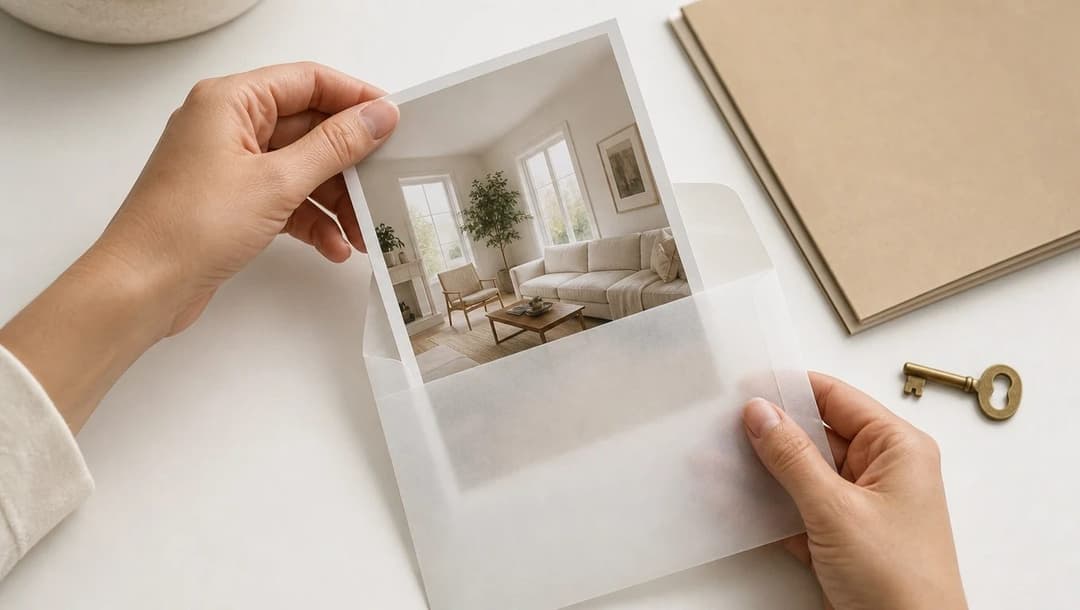
Every time you upload a photo of a living room to redesign it with AI, that image travels. The question almost nobody asks is where to: does it stay stored somewhere? Do people look at it? Is it used to train the models? At Kouzee we process thousands of images of real spaces —clients' homes, interior designers' projects, retail stores— so this question isn't theoretical for us: it's an architectural decision we made when we built the platform. This article explains how it works, so you can decide with the facts in hand.
First, the essentials in one sentence: an AI model is a frozen file of numbers that doesn't learn from your conversations or your photos while you use it — if you want the full explanation of what a model is and how it's trained, I wrote it up on my personal blog. What matters here is what happens around the model: who stores your image, under what contract, and for how long.
Two doors: the free chat and the API
AI companies run two different data regimes, and the difference isn't the provider — it's the door you walk through.
The consumer door is the chat you open in your browser. There, what you feed in can end up training the models: ChatGPT does it by default on personal accounts —free and paid alike— unless you turn it off, Claude asks you when you set up your account, and Gemini uses your activity unless you switch it off. It isn't "only free users": it's anyone who never opened the settings.
The API door is the one used by products built on top of these models, like Kouzee. It's a different commercial contract: that traffic is not used for training, and retention is short and audited. Same company, same model — a different data regime.
What happens to your photo inside Kouzee
When you upload an image to Kouzee —a photo of your living room, a client's moodboard, the render of a project— this is the path it takes:
- It travels over the API. Kouzee sends your image to the generation models through the commercial channel. It never enters anyone's training cycle and it doesn't stay living on the provider's servers.
- It comes back and is stored in Kouzee. The result —your render, your proposal— stays in Kouzee's database, tied to your account, under our rules. Delete it and it's gone.
- Nobody else sees it. Your projects don't feed other users' designs or any training run. What you upload is your working material, not our raw material.
Here's the paradox worth understanding: uploading your client's home to a product like Kouzee can be more private than uploading it to a tech giant's free chat. The chat, if you never checked the settings, has permission to train on that image; Kouzee processes it through a channel that doesn't train and files it in a database you control from your own account.
Why this matters in interior design
Because photos of spaces aren't abstract data. A photo of a living room is the inside of someone's home: their address by implication, their belongings, sometimes the people in it. An interior designer working with AI handles dozens of other people's interiors, and "where do my clients' photos end up?" is a question a client will ask sooner or later. Having a clear answer —they travel over the API, they don't train models, they live in your Kouzee account, they can be deleted— is part of working professionally with these tools.
Our practical recommendation comes down to a single question: do you care what happens to your images? If it doesn't bother you that models train on your taste and your spaces, free chatbots are a perfectly valid way to experiment — just check the three privacy settings first (OpenAI, Anthropic, Google) so it's a decision and not an oversight. But if you want real control over your data and, on top of that, a product built for designing —image generation with interior design tools, proposals with real products, projects organized by client—, start using Kouzee and pick a plan: your images travel through the commercial channel that doesn't train models, they stay safe in your account and protected under our rules.
If you're curious about what comes after the render —turning the approved image into quotable products— we cover it in AI for interior design: more than a render. And if you want to understand the technique behind image generation, it's explained in how AI image generation works.